

Since NASA's Perseverance rover landed on Mars' red dusty surface in February 2021, it has collected a wealth of valuable data. As the vehicle rolled along the inside of the Jezero crater's rim, it literally travelled through billions of years of Mars' history.
In a study published in the scientific journal Science, researchers have used instruments onboard the Perseverance rover to analyse rocks from the so-called Margin Unit – one of the most important geological units in the crater – and have been able to track how the planet's interior, surface water and atmosphere have interacted over time.
‘This is bedrock that was first formed down in Mars' crust from magma. It was then uplifted, exposed at the surface, and reacted with water and carbon dioxide,’ says Sanna Alwmark, researcher at the Department of Earth and Environmental Sciences, Lund University.
A complex history
The analyses show that the rocks are dominated by the mineral olivine, which accumulated in a magma chamber at high temperatures. The rock was then altered in contact with water and carbon dioxide to form carbonate minerals and hydrous silicate minerals – minerals that contain water. This combination points to a complex history: first magmatic processes, then chemical alteration of the magmatic bedrock in contact with water and the atmosphere.
It is primarily the carbonates that make the findings interesting. They are formed when bedrock reacts with water and carbon dioxide and can serve as a geological archive of how a planet's atmosphere has changed over time. On Earth, similar minerals can also preserve traces of biological activity.
‘By tracking how alteration of the margin unit varies with altitude in the crater, we can see how the Martian environment has changed over time. This gives us a more coherent picture of how Mars has evolved,’ says Sanna Alwmark.
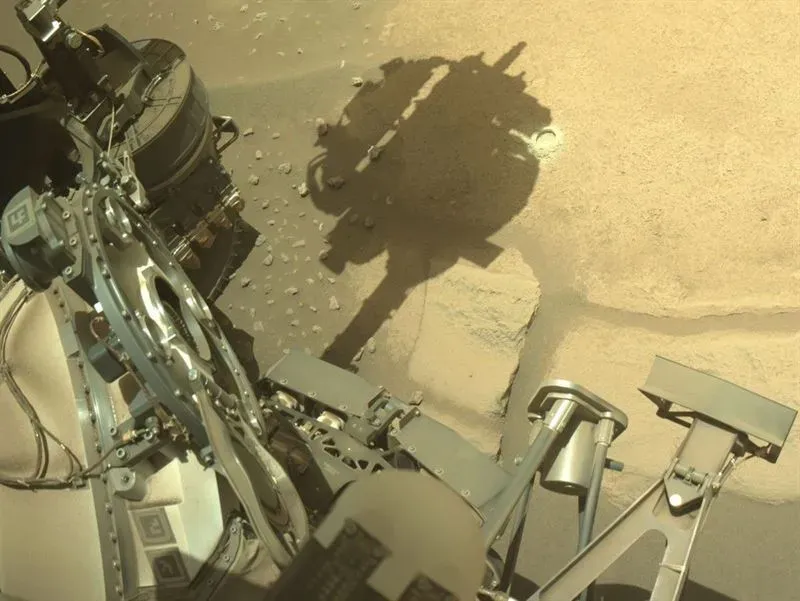
The study shows clear differences within the crater. At lower altitudes, the bedrock is more strongly altered, suggesting that it was under water when the Jezero crater was filled by a lake. Higher up, alteration is less severe, and the rocks there resemble olivine-rich formations found in the surrounding Nili Fossae region.
From water-influenced to a dry planet
The results reinforce the image of the Jezero crater as a place where several of Mars' most important geological processes meet. By reading the chemical signatures of the minerals, it is possible to reconstruct how the planet went from being a more active and water-influenced world to the dry planet we see today.
‘Fundamentally, it's about understanding planetary evolution. By studying how bedrock on Mars was formed, uplifted and then altered in contact with water and the atmosphere, we can follow the processes that shaped the planet over a very long period of time. This is how we can begin to understand how Mars became the planet we see today,’ says Sanna Alwmark.
The study, led by the Blue Marble Space Institute of Science Seattle, is published in Science:
Carbonated ultramafic igneous rocks in Jezero crater (science.org)